Using Poverty As A Prop
The most emotionally charged part of Thomson Fontaine’s speech comes when he talks about people putting groceries back on supermarket shelves. This is real suffering, Dominicans experience it every day. But here is the hard truth: invoking real suffering without offering solutions is exploitation.
Thomson Fontaine says: “I walk into a supermarket, and people are putting back groceries.” He implies that the entire country is full of people who shop blindly, add items to their carts without thinking, then suddenly realize they cannot afford them and start putting groceries back. According to him, ordinary budgeting skills only kick in at the last moment.
This is nonsense. Yes, some individuals may occasionally reconsider purchases, but Thomson Fontaine’s story generalizes it into a dramatic, nationwide spectacle that does not exist. Notice he never includes himself in this scenario. Perhaps he never faces these realities because he is “an amazing economist” or to simply put it, he does not worry about money and the cost of things.
Instead of Thomson Fontaine telling exaggerated anecdotes, Thomson Fontaine could and should show concrete evidence of:
- Where are his policies addressing poverty?
- Where are his structural reforms to create opportunity?
- Where are his measurable interventions that improve people’s lives?
Thomson Fontaine’s speech does nothing to lead to change, it just uses people’s struggles to make his story look dramatic. Real poverty needs real solutions, not stories designed to make Thomson Fontaine seem caring. Using the hardships of everyday Dominicans as a prop for political effect is not leadership, it is theater and exploitation.
The Final Deflection: Mocking Responsibility
Thomson Fontaine closes the video with a line meant to amuse, but that actually exposes his approach to leadership: “Why didn’t I pay for all the people that put back the groceries?”
This statement says it all. A true leader does not mock solutions or treat real problems as a punchline. Real Leaders propose better solutions, take responsibility, and act with accountability. Thomson Fontaine does none of this.
This moment reveals the core issue: criticism without responsibility, outrage without ownership and words without sacrifice. Thomson Fontaine offers nothing to resolve the very problem he highlights, because he has nothing tangible to offer.
By contrast, the Dominica Reform Party has developed concrete policies under the Path Forward framework aimed at addressing poverty and systemic inequality. A Party and leader who truly care.
We do not ridicule solutions, we design them, implement them, and stand accountable for the results. Thomson Fontaine’s sarcastic remark is not wit, it is deflection, and it exposes a lack of vision, responsibility and genuine leadership.
The Personal Comfort Factor: Greed, Privilege, and Political Opportunism.
Thomson Fontaine himself admits: “When I arrived, I was given a chauffeur-driven car, a nice apartment, and I went to work.” But that seemingly casual statement exposes far more than he intended.
For 16 years, Thomson Fontaine remained silent about the issues he now claims to have discovered, not because of fear, courage or principle, but because he enjoyed the benefits and comforts of his position: chauffeured cars, great pay, luxury accommodations, constant media attention and the prestige of being treated like a “rock star economist.”
Thomson Fontaine’s pattern of privilege continued in South Sudan starting in 2017. There, he was treated exceptionally well: high pay, front-row media appearances, frequent public representation alongside leaders and ceremonial recognition. He was not sacrificing; he was enjoying status, influence, and visibility, all the perks of a high-profile assignment. This was exactly the life he sought: attention, acclaim,and material reward.
And yet, when these privileges were disrupted, when he was terminated from positions abroad, refused opportunities in Bangladesh and denied the recognition and influence he had enjoyed, Thomson Fontaine’s story suddenly changes. Sixteen years of silence transform into sudden outrage in one day. This is not moral courage or whistleblowing. It is sour grapes, plain and simple.
The truth is stark: Thomson Fontaine is motivated by self-interest, greed and the desire for personal gain, either to live a lavish, high-profile lifestyle like Roosevelt Skerrit, enjoying status, luxury and attention, or to secure employment and relevance in Dominica after international setbacks exposed the failure of his so-called “10 Pillar Plan” in South Sudan. This pattern leaves only two possibilities:
Thomson Fontaine resented losing the perks, privileges, and “rock star” lifestyle he once had abroad and his attacks are personal vendettas disguised as political concern.
Or he is lying outright, constructing a narrative of moral awakening and systemic critique while conveniently ignoring the years he personally benefited from the same systems he now criticizes.
Either way, Thomson Fontaine’s motivations are not principled. They are self-serving. His chauffeur, his apartment, his press conferences, his public recognition, these were not incidental. They were exactly what a narriscist like Thomson Fontaine was striving for, and when he lost them, he returned to Dominica with a story crafted for maximum political effect. What Thomson Fontaine presents as moral courage and patriotic concern is, in reality, grievance and opportunism wrapped in self-importance.
The “sacrifices” Thomson Fontaine now claims to have made never existed. Every detail of his narrative, his outrage over corruption, his critique of government, must be understood in the context of ambition, jealousy, and greed.
Thomson Fontaine’s moralizing is a facade; behind it is the same drive he has always shown, to secure personal comfort, recognition, and influence whether abroad or at home.
In short, whether he is seeking to recapture the luxurious, high-profile life he once lived or trying to secure a foothold in local politics after international failures, Thomson Fontaine’s actions are motivated not by principle, but by personal gain. His story is about self-interest, convenience, and ambition, not truth, courage, or leadership.
Facts, Law, And The Leadership Dominica Deserves.
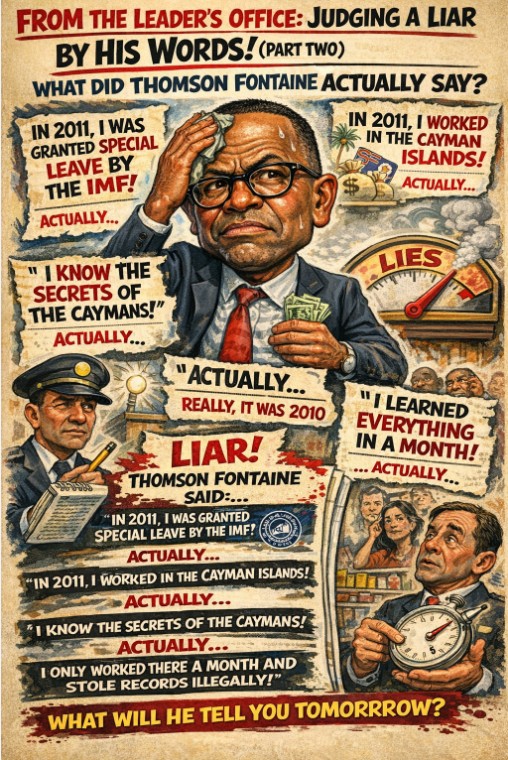
When the facts and the narrative are examined together, they fit like a glove, but only to reveal Thomson Fontaine’s falsehoods. Every element of his story, from the Cayman Islands claims, the “special leave,” the one-month assignment, the illegal access to records, the shifting dates, to the supermarket anecdotes, is either implausible, self-serving, or outright illegal. Nothing he presents aligns with reality, professional norms, or legal standards.
Thomson Fontaine is lying, and it is not a minor slip. It is a pattern: exaggerating accomplishments, manufacturing moral authority and exploiting real struggles of our people for political effect. Thomson Fontaine asks Dominicans to believe in a narrative that cannot withstand scrutiny, while conveniently omitting every detail that would reveal his personal privilege, comfort, and self-interest.
Dominica does not need another fake politician who spins stories, manipulates facts and hides behind rhetoric. We have already seen what comes from unaccountable leadership with Roosevelt Skerrit and his administration, promises unfulfilled, systems exploited and public trust eroded.
What Dominica needs a leaders who propose real solutions, implement measurable reforms and willing to take responsibility when things go wrong. A leader who puts our country’s interest above their own personal gain, recognition, or privilege. A leaders who earns credibility through action, transparency and accountability, not through storytelling, moral pretense, or self-aggrandizement.
Thomson Fontaine’s story does not show courage, insight, or leadership. It shows the opposite: opportunism pretending to be principle, greed pretending to be morality, and showmanship pretending to be accountability. Dominica deserves better. We cannot afford to elect another politician who lives in lies and illusions while real problems continue to hurt real people.
And yet, here we are, the Dominica Reform Party breaking things down, examining every statement, scrutinizing every detail, and getting to the truth. Because make no mistake, local media outlets are not focused on exposing the false narratives, the exaggerations and the convenient stories of politicians like Thomson Fontaine. Too often, they act as gatekeepers, running interference to keep you uninformed, distracted, or misled.
We are not interested in fluff, spin, or emotional hooks designed to make a politician look heroic. We are interested in facts, evidence and accountability. Every claim is being tested, every timeline checked, every so-called revelation analyzed. And what emerges is clear, when you strip away Thomson Fontaine’s rhetoric, the dramatics,and the self-mythologizing, the story does not hold up.
The Dominica Reform Party is committed to transparency, truth and the hard work of leadership, even when it is inconvenient or uncomfortable. We owe it to ourpeople of Dominica to expose falsehoods, to demand answers and to hold leaders accountable for both their words and their actions. Because our country deserves more than stories, it deserves leaders who deliver real solutions, take responsibility and put the country above their own ambition.
In the end, it is simple: win, lose, or we do not run at all. Our goal is not personal glory, it is to show the public exactly what is going on in Domincia. Dominica’s democracy is no longer up for grabs by the best storytellers, the smooth talkers, or the ones who hide behind theatrics and false narratives.
Votes must be cast on truth, accountability and, above all, an informed people. The future of our country depends on citizens who demand facts over fiction, action over performance and leaders who serve the country rather than themselves.
A quick note: if Thomson Fontaine wishes to produce the proof for all of his allegations, we are more than willing to examine it and we would be the first to admit we were wrong. Until that time comes, however, we stand by our analysis, because Dominica deserves leaders whose claims are backed by evidence, not convenience, narrative, or self-interest.