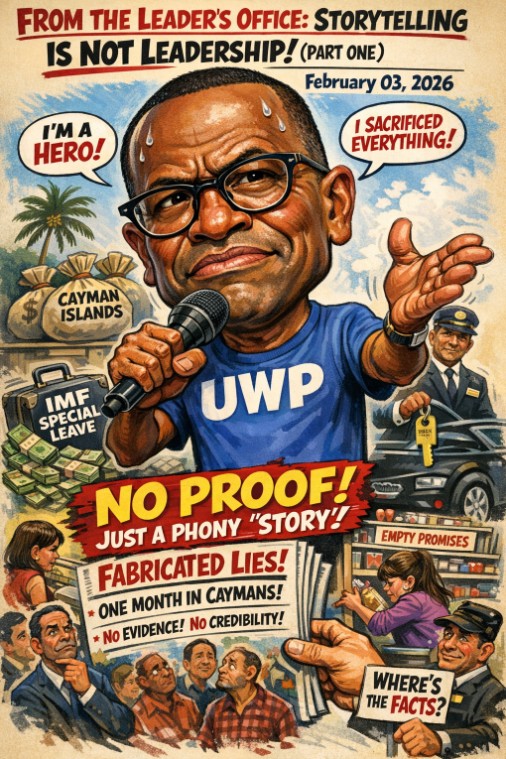
Thomson Fontaine’s opening move is not the presentation of evidence, policy, or verifiable achievement, it is an emotional hook.
When Thomson Fontaine says, “People wonder what it is that is driving you like this?” he is not talking about a real problem or something people are asking about. He is simply telling a story about himself and asking the audience to believe he is heroic and selfless. He is trying to make people think he is morally right before showing any facts or proof.
This is done on purpose. By making himself look like someone who sacrifices, carries a heavy burden and loves his country, Thomson Fontaine is trying to make people feel impressed and sympathetic towards him before they actually look at what he has done. He wants you to believe he is good first, and question his actions later, if at all.
This is not real leadership, it is just storytelling. And when someone tells stories instead of showing proof, it is a red flag. True leaders do not make themselves look heroic at rallies to gain trust. They show their credibility through actions, clear decisions, real solutions and results that can be checked by others.
A rally speech, no matter how passionately delivered, is not proof of service. It is not proof of sacrifice. It is not proof of competence. Without records, results, or third-party verification, it is simply a performance.
You do not earn people’s trust by trying to make them feel emotional or by claiming to be a good person. Trust comes from being accountable, consistent and showing facts that can be checked. When a politician asks people to admire their intentions instead of looking at what they actually do, it is not humility, it is them trying to control the story.
Leadership is not just something you feel inside yourself, it is something you show through your actions to the public. Until someone can back up their claims with real, verifiable proof, what they are saying is just words, a story, not evidence.
The Cayman Islands, Where Money Goes To Disappear.
The Cayman Islands are famous for keeping international people and businesses financial information secret. People often call it a tax haven, not because the money there is illegal, but because the system is set up to hide information and make things hard to see and find.
First, the Cayman Islands do not have direct taxes – no income tax, no capital gains tax, and no corporate tax. This makes it very attractive for companies, investment funds, and wealthy people who want to keep their money out of countries with higher taxes.
Second, and even more important, the Cayman Islands are built for secrecy. Millions of wealthy people, companies, trusts, and investment funds can be set up there without having to share much information publicly. In many cases:
- The beneficial owners (the real people behind the money) are not publicly listed.
- Company directors and shareholders can be nominees.
- Financial statements are not publicly accessible.
- Trust structures can legally obscure ownership and control.
This makes it extremely difficult for foreign governments, journalists, or the public to trace money flows, identify true owners, or connect assets to political actors, unless there is a formal international investigation or court order.
Third, the Cayman Islands are a major global hub for hedge funds and special investment companies. Trillions of dollars flow through their financial system, even though much of it belongs to companies or people based in other countries. The Caymans don’t produce goods or provide normal business services, they exist mainly to handle money and keep it hidden from view.
That is why the Cayman Islands repeatedly appears in:
- Offshore finance investigations.
- Tax avoidance and evasion probes.
- Asset-shielding strategies.
- Corruption and money-laundering cases worldwide.
This is important to understand. The Cayman Islands is not a place where financial transparency happens, it is a place built to hide money and keep things secret. Their financial system is specifically designed to protect information from outsiders, not to make it visible.
“I got special leave from the international Monetary Fund, where I was working as an economist, to go to work in the offshore sector in the Cayman island.”
This “special leave” claim is not a credential, it is the giveaway. Thomson Fontaine emphasizes that he was granted “special leave” from the IMF to work in the Cayman Islands. This emphasis is deliberate. It is meant to suggest that he was so exceptional at his job, so indispensable, that normal institutional rules were bent to accommodate him. But this claim collapses under even minimal scrutiny.
IMF economists do not receive discretionary “special leave” to work in offshore financial jurisdictions based on personal prestige. Outside engagements, if and only permitted, are governed by strict ethics rules, formal approvals, and written conflict-of-interest disclosures. These are procedural, documented processes, not favours granted to individuals.
Thomson Fontaine stresses “special leave” because the truth is far less impressive: IMF staff are not exempt from institutional safeguards simply because they are “that good.” If such leave was legitimately granted, there would be a clear paper trail, terms of approval, scope of work, compliance conditions. Thomson Fontaine has has not produced any of these things.
“In 2011, the Caymen Government invited me to work for one month.”
Thomson Fontaine’s own timeline further undermines his story. Thomson Fontaine states that the Cayman Islands engagement lasted one month.
- One month is not a tenure.
- It is not deep institutional exposure.
- It is not a sufficient amount of time to uncover a decade of systemic corruption.
- It is not a sufficient amount of time to uncover a decade of complex governance failures.
- Or develop the sweeping conclusions he now claims to have drawn.
Yet Thomson Fontaine asks our people to believe that in a single month, in a foreign offshore financial centre, he suddenly experienced a political awakening about Dominica, one that somehow did not compel him to speak publicly, document concerns, or take action for the next 16 years.
This raises an unavoidable question: how does Thomson Fontaine’s one-month assignment justify a decade and a half of silence, followed by sudden moral urgency during an election cycle?
Genuine concern does not appear retroactively and whistleblowing does not wait for political convenience.
When stripped of the rhetoric, what remains is a Thomson Fontaine thin anecdote, inflated by implication: exceptional status without proof, insight without duration and urgency without timing.
In public life, credibility is not built on how a story sounds, it is built on documentation, consistency and action when it matters. Thomson Fontaine’s Cayman Islands account offers none of these. It is not evidence. It is a story, it is a lie.
The one-month timeline alone dismantles Fontaine’s story and reveals possible illegality.
Thomson Fontaine claims that in one month, a brief, temporary engagement, he gained insight supposedly serious enough to justify sweeping allegations and political conclusions about Dominica. That claim does not withstand scrutiny.
- A one-month assignment is not a posting.
- It is not institutional immersion.
- It does not grant deep access, historical understanding, or authority to conclude governance, corruption, or state conduct, especially in a country that was not even the subject of the assignment.
Yet Thomson Fontaine’s own narrative suggests something far worse. Rather than performing the work he was officially tasked with, he admits to illegally searching records, databases, and financial information with the apparent purpose of uncovering incriminating material about a foreign government, a mandate he was never authorized to investigate.
This is not professional diligence. This is an illegal activity. Accessing confidential databases, internal records, or private information for personal, political, or investigative purposes outside the scope of one’s role is a clear breach of privacy laws, contractual obligations and data protection protocols. It is not mission drift, it is unauthorized exploitation of privileged access.
Let us make this very clear. No credible international institution grants temporary staff, with temporary assignments, so they can freelance political investigations, in their free time, about unrelated scandals beyond their official duties.
If Thomson Fontaine’s account is truthful, he violated both the law and institutional rules, committing crimes in multiple jurisdictions. The Cayman Island offshore company that Thomson Fontaine illegally stoled access to, stealing sensitive information should be notified immediately of these admitted breaches, and law enforcement should investigate the unauthorized use and extraction of confidential records.
What Thomson Fontaine has done is take temporary assignment, and is inflating into a moral origin story. One month does not confer moral authority, investigative legitimacy, or retrospective credibility, especially when it involves admitted breaches of law and privacy.
Thomson Fontaine’s story is not proof of anything. It is a made-up version of events built on actions he admits were illegal. The only responsible next steps are holding him accountable, investigating his claims, and notifying the proper authorities.
This is how fabricated stories behave when they are under pressure.
When a story is truthful, the details stay fixed. Dates do not drift. Timelines do not bend. The facts do not change depending on the audience or the point being made.
When a story is fabricated, the opposite happens. As contradictions emerge, the story teller subtly adjusts details to make the account sound more plausible. When something does not quite fit, the story shifts to accommodate the problem. That is exactly what happens here.
Within 40 seconds, Thomson Fontaine moves from 2011 to 2010, recalibrating the timeline to better align with the political narrative he is constructing. This is not how trained professionals recount real events. It is how someone improvises on the fly, when a story starts to appear to unravel.
Thomson Fontaine is not an untrained speaker. He is a highly educated economist, professionally conditioned to work with precise timelines, figures, and sequences. Someone with that background does not casually confuse entire calendar years mid‑sentence, especially when recounting what is supposed to be a pivotal professional experience inhis life. The adjustment is not accidental. It is corrective.
This pattern, altering details when they no longer fit, is a well‑recognized indicator of storytelling under strain, not factual recall. The narrative adapts to survive scrutiny, rather than standing on its own. In short, 40 seconds, the timeline does not change because memory failed. It changes because the story because Thomson Fontaine believed it needed to. And when a story needs to be modified in real time to remain believable, it is no longer evidence, it is construction.
Continue…