There comes a moment when difficult experiences force people to ask uncomfortable questions. For Eexii Read’s family, that question is simple:
Why, through all of this, has not a single ordinary Dominican citizen told him or his father to “Go Back To Canada,” yet every interaction connected to public systems points them in that very direction? That contrast matters.
Every average Dominican they have encountered has shown compassion. Neighbours, community members, and ordinary people who understand hardship, because many have experienced or are experiencing it themselves. They understand that life is not perfect and that people sometimes fall on difficult times. They know that housing situations change, employment can disappear, families can struggle, and children can become caught in circumstances beyond their control.
That is what community looks like. Yet Eexii Read’s experience with the system is very different.
From their inability to get him into high school for the past year, to speaking to Valda Powell at her office, not seeking government financial assistance, but rather information regarding any available community programs, resources, or services that could assist them in overcoming our current situation.
From every meeting involving public officials and social workers, to the interactions of Eexii Read surrounding CHANCES and the 5 unknown individuals involved in questioning him, the impression was not one centred on his family’s stability or offering them support, but on their departure.
“Why not just return to Canada?”
That question should concern every Dominican. Because when the first instinct of public officials, social workers and this administration is to relocate the problem rather than find a resolution, we are no longer discussing compassionate governance. We are discussing a mentality where hardship itself begins to be treated as the problem. And that is where this issue becomes bigger than one family.
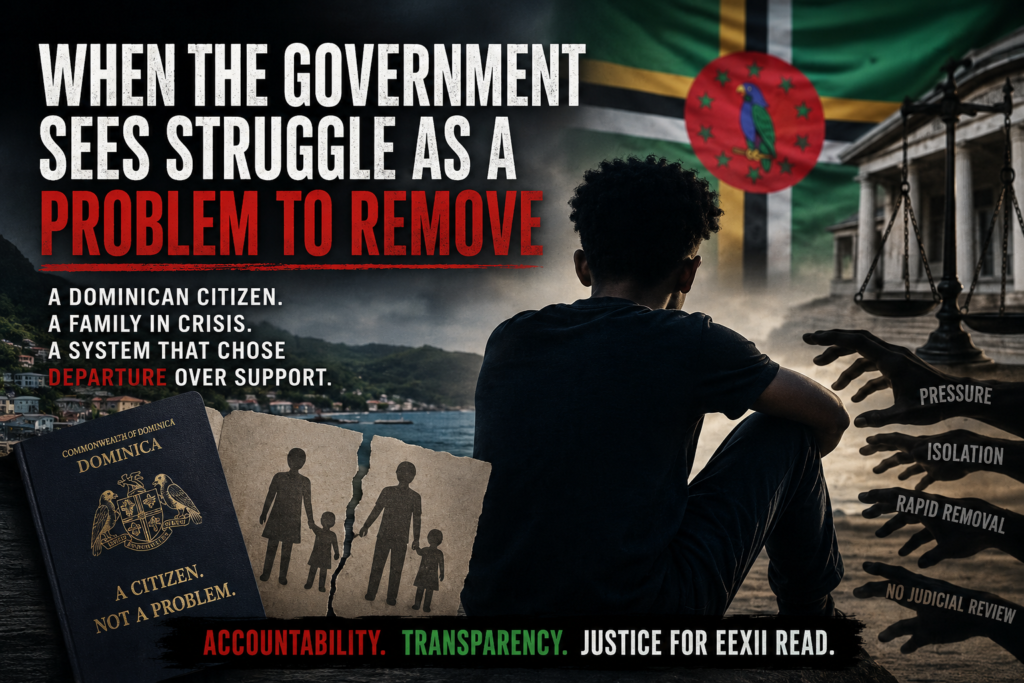
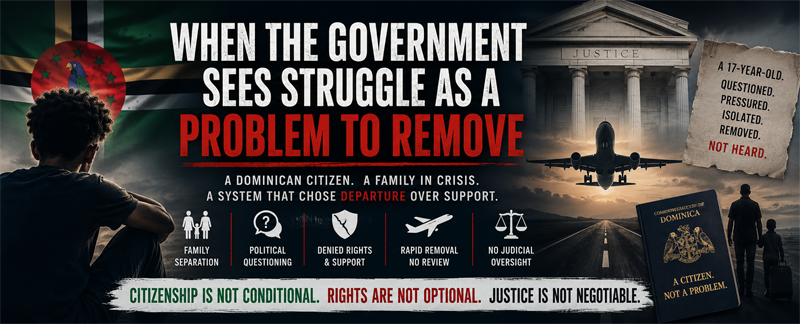
Eexii Read is a Dominican citizen. Not conditionally. Not temporarily. Not as a courtesy or privilege. A Dominican citizen. Yet during the most difficult periods of his family’s lives, the message they were told and are repeatedly confronted with was not, “How do we help this family regain stability?” but rather, “Why don’t you leave?”
That should alarm people. Because citizenship is supposed to mean belonging, not convenience.
A government and its true character and colours are not revealed during press conferences, ribbon cuttings, or carefully crafted speeches. It reveals itself in how its institutions treat people when they are vulnerable.
- Do they help?
- Do they listen?
- Do they protect?
Or do they distance themselves and make struggling people feel like problems to be managed?
What his family experienced reflects a troubling and deeply cold approach to governance. And perhaps this should not surprise anyone. Many Dominicans already live with difficult realities every day. Poverty remains a struggle for too many families. Housing insecurity continues to affect communities. Concerns surrounding healthcare persist. Education and opportunity remain nonexistent for young people. Entire communities know what it feels like to wait for change that has never arrived.
These are not abstract political talking points. These are lived realities. And when people already feel that their own concerns have gone unanswered for years or decades, why should anyone be shocked when families in crisis come away feeling unsupported or unwanted? That is the harder truth.
Governments do not simply fail through bad policy. They fail when compassion becomes conditional. When people begin believing that their struggles are inconveniences rather than responsibilities worthy of government attention, trust starts to disappear. And that is where this Roosevelt Skerrit and his administration deserve scrutiny.
Canada and Dominica share longstanding Commonwealth ties and decades of cooperation and tens of millions of dollars in financial assistance. The relationship between our two countries has long been built on partnership, development, and mutual support.
Yet when hardship entered Eexii Read’s life, his experience did not feel like solidarity. It felt like displacement disguised as guidance.
The father is from Canada. Eexii Read, his son, is a Dominican citizen. And during their experience, all they were left with was that their current difficulties somehow made them less deserving of belonging and more suitable for departure.
That is not compassion. That is not protection. That is not what public support systems are supposed to represent. What troubles this situation most is not merely what happened to their family, but what the experience suggests for others.
Because if a Dominican citizen with foreign connections or foreign nationality ties can be made to feel that leaving is the preferred solution during a period of hardship, what message does that send to every Dominican who holds a foreign passport, dual nationality, or international connection?
- Are they secure?
- Are their rights fully protected?
- Or does difficulty suddenly place their place in society into question?
These are uncomfortable questions. But they matter. At the center of this matter is not politics, personalities, or rhetoric. It is the attempt to remove a Dominican citizen, and the troubling question of why the process appeared to move towards removal with such urgency, rather than first undergoing a full and transparent legal examination by the judicial court.
The situation involved removing a child from his father’s care. A child who is a Dominican citizen. A decision serious enough to affect family unity, liberty, and a young person’s future. That is precisely why the process should have been anchored in scrutiny, judicial oversight, and accountability. Instead, the pace and direction of events raised serious concerns.
What should have been placed before an independent judicial court for examination was moved along a path, outside the judicial system, where departure to Canada became the only and immediate objective. Rather than slowing matters to ensure legal safeguards and independent review, the urgency surrounding removal became impossible to ignore. That is where the heart of this issue lies.
Because when state authorities apprehend a child and separation occurs between parent and child, the public expects more than administrative action. They demand accountability. They demand justification. They demand legal oversight.
- The courts exist for a reason.
- Judicial review exists for a reason.
- Independent examination exists for a reason.
Not to slow justice, but to protect it. Especially when the state exercises power over children and families.
Instead, what unfolded raised difficult and uncomfortable questions about whether speed had become the priority over scrutiny.
- Why was the urgency surrounding removal so prominent? And that is why the circumstances surrounding this matter raise difficult questions.
- Why did removal appear to advance so rapidly?
- Why did the matter not first receive fuller judicial examination, where the reasons, evidence, and legal justification could be openly reviewed and tested?
- Why did the process appear to move toward an outcome, outside of a judicial court, to avoid independent scrutiny that would have taken place?
These are not emotional questions. There are questions about process, accountability, and public trust.
Because when a process involving the removal of a Dominican citizen child appears to move forward with extraordinary urgency, people have to naturally begin asking whether legal scrutiny was being treated as an essential safeguard or something to be moved past as quickly as possible. That concern cannot be dismissed, because it goes directly to confidence in public institutions.
Following the apprehension and separation, pressure on his mother, surrounding Eexii Read’s rapid travel arrangements and return to Canada within days, escalated. The speed at which these arrangements were being pushed forward became a central part of the concern.
Rather than a gradual or carefully managed process that allowed space for stability and proper review, events appeared to be fast-tracked towards an immediate departure outcome within days.
It was that urgency, how fast everything progressed after the initial separation, that raised questions about why the situation unfolded at such an accelerated pace, and why so little time appeared to be given before major decisions were being advanced.
And when urgency dominates before independent judicial review occurs, it leaves people questioning whether proper safeguards were receiving the priority they deserved.
No government should fear judicial examination of serious actions affecting children and families. In fact, courts exist precisely so governments and public authorities must justify actions openly and transparently before an independent authority.
That is not hostility toward government. That is how accountability works. Because if the actions were fair, lawful, and justified, then independent scrutiny strengthens public confidence rather than threatening it. This is why the issue matters beyond one family.
But this issue does not end with Eexii Read’s family. That is precisely why it matters. Because if a Dominican citizen born abroad can face circumstances where removal is pursued and encouraged despite holding Dominican citizenship, then every Dominican with foreign birth, dual nationality, or a foreign passport has a reason to pay attention.
This is no longer simply about one child. It becomes a question about what citizenship means.
Does Dominican citizenship stand on its own as a protected and equal status? Or can birthplace and foreign nationality connections suddenly become factors that place that security into question? Those are serious questions. And they should be a concern for every family.
Dominica is not a country made up only of people born within its borders. Its history and identity are deeply connected to migration, diaspora families, Commonwealth relationships, and citizens with lives stretching across multiple countries. Many Dominicans are born abroad. Many hold foreign passports alongside Dominican citizenship. Many families live across borders while maintaining deep ties to this nation. They are no less Dominican.
Their citizenship should not be viewed as conditional, secondary, or vulnerable because of where they entered the world or what other travel documents they hold. That is why the implications of this matter feel so significant.
Because when circumstances arise where the removal of a Dominican citizen born abroad appears capable of advancing with extraordinary urgency, people must ask the difficult questions about precedent and protection.
If birth abroad can become a factor in how citizenship is treated during times of crisis, where does that thinking end? Today, the concern may involve a Dominican citizen born overseas. Tomorrow, people may begin asking whether dual nationality or possession of a foreign passport itself could create unequal treatment or vulnerability.
These questions should never be dismissed as impossible. History teaches us that rights often appear secure until the moment they are tested. And citizens should never become complacent about the protections that belong to them under law. That is why this issue matters beyond politics and beyond personalities. Because citizenship must mean certainty.
- Not uncertainty..
- Not hierarchy..
- Not a status that feels stronger for some and weaker for others.
Dominican citizenship should not depend on birthplace, foreign ties, convenience, or political circumstance. And if people think these concerns are too far-fetched or could never affect them, they should remember something important:
Many things appear impossible – until they happen. That is why public scrutiny matters. That is why judicial oversight matters. And that is why governments must never be permitted to operate beyond independent examination when actions involving children, citizenship, and family separation are involved.
Political disagreement is part of democracy. Public criticism is part of democracy. And governments, regardless of party, should expect accountability when citizens raise concerns about power, process, and fairness. Democracy is not measured by how governments treat supporters during comfortable times. It is measured by how its institutions respect rights, withstand scrutiny, and respond when serious questions are asked. That is the larger issue at stake. Not simply what happened to one family.
But whether every Dominican, whether born here or abroad, whether holding one passport or several, can feel equally protected by the citizenship they possess and the nation they call home.
When this situation is viewed in its full political context, the question of intent becomes impossible to avoid.
Was it simply a coincidence that these events unfolded in a way that removed a key figure connected to a political movement at a critical time? Or does the timing and potential outcome raise legitimate questions about what the intended direction of the process actually was?
Because the result is not in dispute: Eexii Read was removed from his father, his family was disrupted, and his politically active connection was effectively taken out of direct engagement within Dominica. That is where questions of intent arise.
- Why did the process move with such urgency?
- Why did it appear to progress in a way that led so quickly toward removal and separation?
- Why was there no judicial review from the judicial courts for the removal of a Dominican citizen?
- And why did the outcome align in a way that had clear political consequences, including reduced participation and presence at a time of active public opposition?
Remember, while Eexxii Read was at CHANCES, a sequence of events unfolded that raises deeply serious concerns about how he was treated and how the situation was handled from the beginning.
During this time, he was questioned extensively about his political views, associations, and ambitions. That matters because for a 17-year-old already in a vulnerable and unfamiliar environment, the nature, repetition, and direction of these questions created significant emotional strain and confusion.
At that age, and in that setting, those questions are not abstract. They are felt as loaded. They carry implications about how he would be perceived and what weight his answers will have in a situation where he had no control. That raises a serious concern.
Why are political views and associations part of questioning at all in a situation involving a child in state care?
During his time at CHANCES, he witnessed and experienced incidents of physical assaults involving objects and weapons directed toward himself and other children. These incidents had a significant psychological impact on him and contributed to a heightened sense of fear, confusion, and distress. These matters are being raised for formal investigation, as the child indicates that there is physical evidence and observable indicators that may support these accounts.
In addition, the environment described included ongoing psychological pressure, lack of clear communication, and denial and inconsistency in access to services and support that should have been available in state care.
In that kind of setting, even without anything being explicitly stated, Eexii Read easily began to feel that his identity, associations, and perceived beliefs were being closely observed and influencing how he was treated and understood within the system.
When these elements come together, uncertainty in communication, emotional pressure, and the perception of being scrutinized it creates a deeply destabilizing experience for a young person who is already separated from family and trying to understand what is happening around him.
That kind of environment creates pressure. Not necessarily through direct statements, but through implication, repetition, and circumstance. And that is why it is so troubling.
A child in state care should never feel that political considerations, real or perceived, have any place in how his welfare is being assessed or how decisions about his future are being made. The standard must be consistent for every child: safety, stability, and well-being above everything else.
Remember that he is 17 years old. Old enough to understand exactly what is happening around him. Old enough to understand the political climate in Dominica. Old enough to recognize when questions are not just casual or harmless, but carry weight in the real world he is living in.
This is not a child who is 5, unaware or disconnected from reality. And that is what makes what happened to him even more troubling. Because during a moment of extreme vulnerability, already separated from his father, already inside a state-controlled environment, he was questioned about political views, personal beliefs, affiliations, and associations.
These are not neutral questions in that setting. Not to a 17-year-old who understands how power works in a small country, and how words can be interpreted when you are not in control of your environment.
In that moment, Eexii Read understood something very clearly:
- What he said,
- How he responded,
- And what he was perceived to believe.
It would affect how he was treated and what direction his situation would take. That is not a small thing for a teenager to carry. And it is not something that should be present in a process that is supposed to be focused on care, safety, and stability.
Instead, it created pressure. Psychological pressure. The kind that builds in an environment where a young person is trying to figure out what is “safe” to say, what is “expected,” and what might influence decisions being made about their future.
Combined with the separation from his father, restricted communication during critical moments, integration into an unfamiliar environment with strangers, pressure surrounding return to Canada, the physical assaults he experienced and witnessed on other defenceless children, the physiological pressure staff was putting on him, and the speed at which events appeared to be moving toward removal from Dominica, the experience became deeply overwhelming.
Not slow. Not measured. Not carefully processed. Fast. Disorienting. Pressurized. And in that environment, a 17-year-old is not just answering questions; he is trying to survive. He is trying to navigate a situation where he is aware that the wrong response, or even the perceived wrong stance, would shape what happens next. That is what makes this so serious.
Because whatever the official framing of events may be, the reality is this: Eexii Read was placed in a high-pressure state situation where political-type questioning and rapid decision-making became part of an already deeply distressing process. And that raises hard questions about appropriateness, safeguarding, and the kind of pressure a young person should ever be placed under when their future and family separation are already on the line.
The conditions surrounding him were not stable or reassuring. Instead, the situation escalated rapidly over 36 hours, with no opportunity for calm explanation, consistency, or grounding support, just a barrage of questions and encouragement to go back to Canada.
Communication with his father and legal counsel was also denied during critical moments of separation and questioning. This added another layer of distress at a time when representation should have been most protected.
What stands out most is the intensity and speed of what followed. Rather than a gradual, transparent, and carefully reviewed process, events appeared to accelerate quickly toward removal from Dominica within a 3-day timeframe.
During this period, the emotional pressure placed on Eexii Read, combined with isolation and uncertainty, created a situation that was extremely distressing and difficult to understand from a safeguarding perspective.
At no point was there any clear, visible, and fully tested judicial process at the outset to openly examine and justify the basis of what was happening. Instead, the trajectory of events moved rapidly toward deportation and his departure.
Eexii Read’s experience at CHANCES and what followed raises serious concerns about how vulnerable children are managed once they enter state care, particularly when decisions move quickly toward separation and relocation.
It also raises difficult questions about whether sufficient safeguards, independent review, and time for proper assessment were fully explored and applied before the process toward Eexii Read’s removal from Dominica was effectively set in motion.
In a situation of this seriousness, affecting a child, family separation, and a decision with permanent consequences, the expectation would normally be that every step is carefully examined before any direction toward the removal of a Dominican citizen is advanced.
When events appear to move quickly toward an outcome of that magnitude, it must raise concerns about whether the necessary checks and balances, oversight, and deliberate assessment were fully given the time and attention they required.
Because no Dominican citizen should ever be left wondering whether decisions affecting their future can be pushed forward without adequate accountability and transparency. And if citizens begin to feel that vulnerability makes them easier to remove from view rather than support, the issue becomes larger than one case. It becomes a national question.
- What kind of country do we want Dominica to be?
One where support exists only when life is going well? Or one where institutions stand beside people during hardship? The harsh reality is this:
A government does not prove its compassion by speaking about care. It proves compassion through action. And this administration increasingly appears disconnected from the struggles many people face.
Because when poverty persists, housing remains difficult for many, healthcare frustrations continue, and opportunities remain limited, citizens are left asking whether the government truly understands life outside political offices and official statements.
And if people feel their own hardships are not priorities, then perhaps it becomes easier to understand why families like Eexii Read’s come away feeling that they, too, were treated as inconveniences.
That should concern everyone. Not because his family is unique. But because his experience reflects something much broader. If the instinct of institutions becomes to encourage departure instead of assistance, then hardship itself becomes stigmatized.
- People become afraid to ask for help.
- Families stay silent.
- Citizens lose confidence.
- And societies grow colder.
The ordinary Dominican people they have met have not shown them that coldness. Quite the opposite. They have shown kindness and understanding. That is why the contrast with the interactions with public officials and social workers and this administration looks and feels so stark.
This is not an attack on Dominica. It is a call to ask whether its institutions are living up to the compassion and humanity that ordinary Dominicans demonstrate every day. Because no Dominican citizen, child or adult, should ever feel that their place in their own country becomes uncertain when life becomes difficult.
- Citizenship cannot become weaker during hardship.
- Rights cannot depend on convenience.
- And public systems cannot lose sight of the people they exist to serve.
These are not anti-government questions. They are pro-accountability questions. These are questions any government administration around the world must answer.