
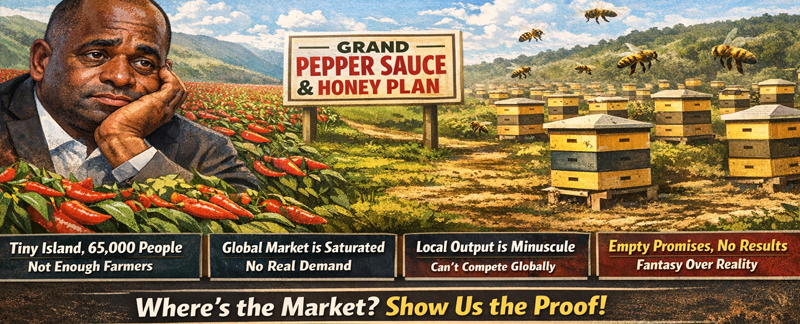
Another unrealistic and ambitious promise from Roosevelt Skerrit, this time centered on pepper sauce producers and beekeepers. Let us take a closer look at what it really means.
Dominica is a tiny island with a population of approximately 65,000 and is ranked 204th in the world by population, and it is only 29 countries above being the least populated country on Earth. So, exactly who is going to farm all these peppers and tend all these beehives?
There simply are not enough farmers to make this “plan” anything more than a Roosevelt Skerrit’s talking point. You are essentially being offered an economic vision that depends on a workforce that does not and cannot exist.
Even if every farmer in Dominica wanted to dedicate their land solely to pepper farming or beekeeping, the scale of production would remain minuscule, as there is no way to generate enough crops to meaningfully compete globally or even regionally. Also these sectors do nothing to tackle our nation’s unemployment or create broad-based economic opportunity. At best, a very small niche of individuals might prosper, but the vast majority of our population would see absolutely no benefit.
This is just another classic Roosevelt Skerrit fairytale, wrapped in the same tired rhetoric that agriculture will “save” our island. After 25 years in power, he has built nothing, no industries, no real economic growth, just empty promises. The only base he can play to is the farmers, because he has created nothing else. He leans on the agricultural sector as if it is a magic bullet, knowing full well that relying on this small slice of the population does nothing for the majority of Dominicans.
Foreign investors avoid risk, small islands with unstable political climates, and extreme poverty—among two dozen other factors that have effectively blacklisted Dominica in the eyes of the international business community. The first clear signs of this ongoing failure were the banks pulling out, followed by Ross University abruptly leaving without any justifiable or logical reasoning. Banks make money; they do not walk away from profits easily. When they withdraw, “banking risk aversion” it is a clear signal that they do not trust the government to manage the economy responsibly or maintain political stability. This erosion of confidence was the first warning that Dominica’s reputation on the global stage was being undermined, and the effects continue to reverberate, discouraging future investment and limiting opportunities for sustainable growth.
So this leaves Roosevelt Skerrit with a single, glaring problem and he has to resort to his only play. Pitching small-scale, niche-market jobs as the island’s economic savior, even though these markets barely reach beyond our shores.
It is a pitiful attempt to appear competent—after 25 years in power, he has built nothing. This so-called national economic strategy is little more than a hollow scheme to funnel a meager trickle of income to a select few, while the vast majority of Dominicans continue to suffer.
So yes, if your goal is simply to stock local supermarkets with peppers and honey, that is entirely achievable, but you do not need Roosevelt Skerrit to do that. The idea that this could drive real national economic growth, create meaningful employment, or put Dominica on the global stage? That is pure fantasy, just like Roosevelt Skerrit’s marijuana dream that is now gathering dust on the back burner for years.
Roosevelt Skerrit excels at offering grandiose visions of wealth and prosperity for Dominica, but the reality tells a different story. While he has personally accumulated wealth since taking power, the tiny island’s population continues to struggle, and the dreams he sells remain just that—dreams that never materialize for anyone but himself.
When it comes to world pepper production, the numbers are staggering. Vietnam alone produces between 551 and 661 million pounds each year, making it one of the planet’s top producers. Brazil, Indonesia, India and China also contribute tens of millions of pounds annually. Altogether, global pepper production totals roughly 1.87 billion pounds per year.
In contrast, Dominica’s pepper industry, even with recent improvements, consists of roughly 80 smallholders working small plots. There is no indication that Dominica could ever produce even 2,000 pounds annually—let alone the millions required just to begin thinking about participating meaningfully in global supply chains or export markets.
To put it into perspective:
- Global leaders are producing hundreds of millions of pounds each year.
- Our tiny island nation with limited land and labour capacity could not even produce about one ten-thousandth of one percent (0.000107%).
Even if every capable farmer in Dominica devoted themselves full-time to pepper production, the output still would not be enough for our island to register in global statistics.
Looking at honey, the disparity is even more extreme. China produces roughly 992 million to 1.08 billion pounds of honey per year, far more than any other country. Other major producers like Turkey, India and Argentina each contribute tens of millions to nearly 200 million pounds annually. Worldwide honey production totals around 4.19 billion pounds per year.
By comparison, even a few thousand hives on our small Caribbean island would produce nothing in comparison to the global total, orders of magnitude too small to even be a thought, let alone competitive in export markets.
Ukraine, a significant European producer, has hundreds of thousands of hives and produces nearly 200 million pounds of honey annually. If Dominica only scaled to a few thousand hives, still an extremely ambitious local goal, the output would be a rounding error compared to global production totals.
Why Hundreds of Thousands of Beehives Would Destroy Dominica’s Ecosystem.
Imagine if we could flood Dominica with hundreds of thousands of beehives. On the surface, it might look like a golden opportunity, jobs, honey production and economic growth. But the reality is far more dangerous. Our island is small, with fragile ecosystems and limited natural resources. Introducing such an enormous number of bees would overwhelm the environment, creating competition that our native plants and pollinators simply cannot survive. Native bees, butterflies and other pollinators would be pushed out and some would face local extinction. The very biodiversity that supports our agriculture and forests would be under threat.
The strain on our flora would be immediate and severe. Bees require vast amounts of nectar and pollen. With hundreds of thousands of hives consuming these resources, native plants and crops that rely on local pollinators could fail to reproduce. Monoculture farming to feed these hives would further reduce plant diversity, harm soil health and create long-term instability in our ecosystem.
Disease is another hidden danger. Large-scale beekeeping spreads parasites and pathogens like Varroa mites and Nosema. These diseases would not stay confined to the managed hives, they could infect wild pollinators, devastating species that have no immunity. What may seem like an economic solution would quickly become an ecological crisis.
And let us not forget the limits of the island itself. Dominica’s terrain is mountainous and forage for bees is finite. Even if we attempted this on a massive scale, the hives would struggle to survive and honey production would collapse. Chemicals used to protect crops would pollute soil and water, creating additional environmental hazards.
In short, turning Dominica into a hub for hundreds of thousands of hives is not just impractical, it is dangerous. The environmental and ecological costs would far outweigh any small gains. Roosevelt Skerrit’s vision may sound ambitious, but in reality, it risks destroying the very natural systems that make our island unique and sustainable. Any real economic strategy must protect our environment, not gamble with it.
Hope vs. Arithmetic.
In the global pepper and honey markets, supply overwhelmingly exceeds demand. Production is so abundant that every need, whether culinary, industrial, or commercial is fully met with plenty left over. There is no real scarcity, no looming shortage and certainly no pressure on consumers.
In these markets, the concept of unmet demand is non-existent. Surplus is the norm and any fluctuations in consumption or minor disruptions in production have basically no impact. Prices and trade are shaped more by logistics, storage and efficiency than by competition for limited resources. Essentially, these are markets that not only satisfy demand but consistently exceed it, creating a landscape of abundance rather than scarcity.
What Roosevelt Skerrit is not telling you, and will never tell you is that in an oversupplied global market, there is effectively no opening, no gap and no realistic opportunity for our tiny island economy to compete against the massive, industrial-scale agricultural giants dominating the world stage.
No matter how grandiose his promises, how optimistic his slogans, or how much he leans on hope and rhetoric, the reality is brutal. The worlds shelves are already stocked, the contracts are locked, the distribution networks are controlled and the small producers of Dominica are simply incapable of carving out any share of a market that overwhelmingly dwarfs them.
Even if you talk about structural advantages, technology, efficiency, value-added processing, branding power and trade leverage. The hard reality remains that when global supply already exceeds demand, there is no shortage waiting to be filled.
- You are not entering a hungry market.
- You are entering a saturated one.
And in saturated markets, small players do not set prices; they accept them and the “big dogs” dominate through scale. They produce more. They ship more. They absorb losses longer. They undercut pricing when necessary. If you try to enter, they will simply out-supply you and out-price you.
That means margins diisappear before you even begin. It means your national strategy depends on competing in a race where the outcome is already structurally tilted against you. This is not about pessimism. It is about arithmetic.
Roosevelt Skerrit, Where’s the Market?
If supply already exceeds demand globally, producing more does not create opportunity; it creates oversupply. And in oversupply, the smallest producers are always the first to feel the squeeze.
Ask Roosevelt Skerrit a simple, direct question: Where is the market? Not the slogan. Not the vision statement. Not the political promise. The actual market. If global supply already exceeds demand, then who exactly is waiting to buy what we intend to produce?
Ask Roosevelt Skerrit to show the numbers. Show the verified demand data. Show the signed purchase agreements. Show the price forecasts. Show the margin analysis after shipping, insurance, certification, storage and distribution costs. If the plan is real, the evidence should be clear and measurable.
Because in saturated markets, you are not filling a gap; you are trying to force your way into a crowded space, a space where the largest producers already dominate distribution networks, control supply chains and can lower prices whenever competition appears. They can afford thinner margins. Small economies cannot.
So the question is not whether we can produce. The question is whether there is profitable, sustainable demand that justifies the risk. If the global market is already oversupplied, then producing more does not create opportunity. It creates vulnerability.
If Roosevelt Skerrit cannot clearly demonstrate where the unmet demand exists and how we can compete without being undercut, then the public deserves to know that. A national economic strategy must be built on data, contracts and realistic market positioning, not lies of hope.
Before asking our citizens to invest their future in expansion, the burden of proof lies with Roosevelt Skerrit who is proposing it. Show the market. Show the math. Show the plan.
The Reality Behind Roosevelt Skerrit’s Pepper and Honey Promises.
Do not get us wrong, there is nothing wrong with supporting small pepper farms and beekeeping. These activities can improve incomes for a handful of farmers, supply local supermarkets and build small artisanal brands. But the reality is that when you look at the numbers, anything past that is not there.
We understand and respect the hard work of our pepper producers and beekeepers. What you are doing is important and we want nothing but the best for you. But we all have to be realistic. Be real – your hobbies and part-time jobs are just that. You will never become rich or live a lavish lifestyle like Roosevelt Skerrit. You will struggle to sell your products and unfortunately, that is the reality for most people in niche agricultural markets on a small island.
The Dominica Reform Party offers a different kind of hope. Our vision is to grow the population, expand the economy and create real, new and alternative ways for people to earn a living. That includes new industries, sustainable tourism, renewable energy projects, manufacturing and skills-based programs that give our youth and adults meaningful work opportunities.
Your pepper and honey ventures can hopefully be supported and sustained locally once the economy is stronger, and if not, we will find other ways to help you support your families.
The first step is to sit down and have a real discussion. We want to hear your ideas, your thoughts, your vision and how you think you could contribute to economic growth.
But be prepared: your ideas will be challenged. Unlike Roosevelt Skerrit’s administration, we will not just agree because you ask us to. You will need to back up your proposals with facts and show that your udea has a realistic vision with growth potential.
The Dominica Reform Party government will not simply hand out money or offer charity to quiet complaints. This is about responsible spending and clear visions for national development. If your idea is well thought out, viable and capable of producing profitable results, we will support it. But do not expect that merely asking will be enough; we will work together, but only with a plan that has legs and can make a difference.
In closing, The Dominica Reform Party understand something important: people are hurting. When times are hard, when incomes are tight and opportunities feel limited, even ideas that once seemed far-fetched can start to look promising. It is human nature. When you are searching for relief, every proposal feels like it will be the breakthrough. We all believe, at some level that the golden goose idea in front of us will work.
But belief does not override arithmetic. Dreams do not cancel out supply curves. Hope does not rewrite global market history. The numbers matter. The trends matter. The realities of oversupply and price competition do not bend simply because we want them to.
And that is where the uncomfortable question comes in regarding Roosevelt Skerrit. For decades, these sectors were not a national priority. Why now? For decades, there were not even a second thought for Roosevelt Skerrit, they had little urgency and little aggressive positioning of small producers into competitive global markets. Suddenly, after 25 years, the Domincia Labour Party finds a new urgency, a discovery, a new “epiphany.”
Our people have a right to question the timing. They have a right to ask why long-standing struggles were never addressed earlier. They have a right to examine whether new promises are grounded in structural planning or political survival.
No one should be dismissed or insulted. But no one should be naïve either. When people are struggling, they are vulnerable to big promises. When communities are desperate for change and money, they are more willing to believe in sweeping solutions. That is precisely why scrutiny is necessary.
If an economic pivot is real, it should stand on transparent data, long-term strategy and clear competitive advantages, not sudden enthusiasm after over two decades of neglect. Leadership must be measured not by late awakenings, but by sustained results.
- You deserve more than inspiration.
- You deserve evidence.
- You deserve a strategy.
And you deserve honesty about the risks as well as the rewards.