There are moments in a country’s life when citizens must stop arguing about personalities and start paying attention to patterns. Dominica is at such a moment.
When Prime Minister Roosevelt Skerrit says, “I will lead this country until Jesus Christ comes,” and that he will remain in office “with the help of God and the people of Dominica until my son Dmitry starts making children,” these are not jokes or throwaway lines. They reveal a dangerous mindset, one in which he views his political power as permanent, personal, and inherited, rather than temporary and accountable.
Democracy does not permit lifetime rule, nor does it allow power to be inherited. Leadership exists only through the consent of the people and only within clear limits. When Roosevelt Skerrit makes statements like this, they should be treated as a serious warning.
History is unambiguous on this point: when a a world leader publicly normalizes the idea that only God, time, or bloodlines will end their rule, democracy is already being weakened. That mindset is a defining characteristic of authoritarian systems, not democratic ones. That the idea of them leaving office is not a realistic or acceptable outcome in their mind.
History hasalso shows that democratic decline rarely begins with force; it begins with words that test boundaries and silence that allows them to pass unchallenged. Remaining silent in moments like these does not preserve stability; it accelerates the erosion of democratic norms and places the future of Dominica at real risk.
This is not the language of a true leader who views public office as a responsibility entrusted by the people. It is the language of someone who sees their power as permanent – untouchable, unshakable, and above the will of voters, a dictator.
Roosevelt Skerrit is a leader who cannot imagine leaving power. That mindset alone is a threat to our democracy. When any leader of a country begins to believe they are irreplaceable, the democratic system that put them in office is the very thing placed at risk.
Leaders who speak this way do not govern like democrats; they govern like rulers. This is the language commonly used by dictators and strongmen, those who blur the line between public service and personal entitlement, between democratic consent and permanent control.
History has proven time and time again what happens when a leader holds power for too long. Government institutions weaken, rules are ignored, and the people lose their voice. Public trust erodes. Corruption grows because checks on power and safeguards disappear.
The economy suffers, inflation skyrockets, poverty rises, while wealth concentrates in the hands of a small circle connected to those in power. Education, healthcare and pubic services decline as priorities shift from serving citizens to protecting authority.
Violence and murders begin to occur more frequently, and drug-related issues dominate the news and everyday conversation. Freedom of the press and the right to protest are restricted, as criticism is increasingly treated as a threat rather than a vital safeguard of democracy.
Read that again carefully. Ask yourself honestly. Does this resemble what is happening in Dominica right now, today?
If you believe it does, then there is reason for serious concern. Because when these patterns appear, they are not accidental – they are 100% warnings. And the direction they point to is one that no democratic society should accept.
When loyalty to one person replaces loyalty to the law, elections stop being a safeguard, and they become moments of tension, unrest, and sometimes violence.
Look at countries where this has happened before:
1. Rafael Trujillo – Dominican Republic. (1930–1961)
Rafael Trujillo ruled the Dominican Republic for more than 30 years with an iron grip. His dictatorship was marked by widespread corruption, nepotism, suppression of dissent, and violence.
Trujillo’s regime was responsible for brutal repression, including the massacre of tens of thousands of Haitians in 1937, and extensive human rights abuses. His long rule concentrated power in one leader and his family, and the country suffered the social and economic costs of that authoritarian control.
2. Cuba – One‑Party Authoritarian Rule. (since 1959)
Cuba has been governed as a one‑party socialist state since the revolution led by Fidel Castro. Decades of single‑party rule have brought economic shortages, limited political freedoms, and restricted civil liberties for everyday Cubans. While the regime has survived for generations, it has done so at the cost of political pluralism and economic opportunity for its people, which is widely documented.
3. Venezuela – Concentration of Power Under Chávez and Nicolas Maduro. (1999–2026)
Venezuela offers a modern regional example of what happens when power becomes concentrated over time. Under Hugo Chávez and then Nicolas Maduro, the country’s democratic institutions were eroded, leading to economic collapse, hyperinflation, shortages of food and medicine, and mass emigration of millions of Venezuelans.
Maduro’s increasingly authoritarian rule saw the repression of opposition and controversial elections that many international observers criticized as flawed.
4. Haiti – Political Instability and Erosion of State Capacity. (since 1957)
In Haiti, years of political turmoil, weak governance, and authoritarian stints have contributed to a near collapse of state authority in the country. Violent gangs now control large areas of Port‑au‑Prince; everyday life is marked by insecurity, violence and basic services that are failing.
While not a traditional dictatorship, the long absence of stable, accountable governance shows what can happen when institutions break down, and power becomes fragmented outside democratic norms.
5 – United States of America – Insurrection in the Capitol. (2021)
January 6, 2021, is a stark reminder that democracies can be shaken not only by force but by words. No foreign enemy attacked the United States. No economic collapse drove the nation to the edge. The crisis was fueled by the reckless language of Donald Trump, then President of the United States- a leader who used his platform to sow doubt, inflame grievance, and undermine trust in a lawful election.
The result was an assault on democratic order itself. January 6 proves that when a leader repeatedly suggests they cannot lose, should not lose, or will not accept loss, democracy is already in danger, long before any constitution is torn up or any term is officially extended.
When words are untethered from public accountability, they become catalysts for action. In this case, reckless speech from the highest office was enough to push a nation toward chaos and place the peaceful transfer of power in jeopardy.
DO NOT KID YOURSELF INTO BELIEVING that Dominica is immune. Dominica should not assume it is immune simply because we are small. Ignoring these warnings and patterns is a risk we cannot afford to take.
Now let’s talk about other concerns weighing on the minds of many Dominicans today.
There have been recent regional allegations – including in the international press – about corruption and drug trafficking linked to powerful political networks across the Caribbean and Latin America. These allegations are serious enough that Dominica’s government has had to publicly deny involvement and state that there is no factual basis that officials here were implicated in such activities.
What is documented by reputable sources is that a U.S. indictment accuses Venezuelan President Nicolás Maduro and others of running a transnational drug network that bribed officials along the “Caribbean route” to protect cocaine trafficking. This includes allegations of corruption in multiple countries as the cocaine moved north.
In addition, there are currently serious allegations circulating in the public domain concerning Roosevelt Skerrit, members of his family, and individuals within his administration.
It is important to be clear that these claims have not been independently verified by reputable investigative journalists or law enforcement authorities, and Roosevelt Skerrit has publicly denied any wrongdoing.
However, the fact that allegations are unverified does not automatically make them untrue. It simply means that, at this point, they have not yet been fully tested, substantiated, or dismissed through proper and transparent investigation. In a healthy democracy, such matters are examined seriously, not ignored or silenced, so that the truth, whatever it may be, will eventually come to light.
Allegations Circulating Online (Unverified Claims)
These claims are widely shared on blogs, social media, and commentary sites, but they do not appear in verified investigative journalism or court records at this time:
- Claims that Roosevelt Skerrit arranged for a Dominican drug trafficker with an INTERPOL Red Notice to be returned to Dominica instead of extradited.
- Claims that Roosevelt Skerrit personally attended the funeral of a major drug trafficker, and that individual was never investigated due to his relationship with Roosevelt Skerrit.
- Claims that a Dominican journalist who mentioned Roosevelt Skerrit in a drug‑trafficking story had his car firebombed shortly afterward.
- Claims that Roosevelt Skerrit has openly associated with drug traffickers who operate with impunity in Dominica because of his protection.
- Claims that Alex Saab, the Colombian businessman linked to the Maduro regime, maintained offshore banks in Dominica before opening one in Antigua.
- Claims linking Roosevelt Skerrit to a 2012 double murder in Antigua, where narcotics were found.
- Assertions that the mainstream media has ignored Roosevelt Skerrit’s “incestuous relationship” with traffickers because journalists fear retaliation.
- Suggestions that Roosevelt Skerrit’s name might appear in sealed U.S. federal drug or money‑laundering indictments connected to the Maduro case.
Other Allegations Circulated Publicly
- Accusations that Malik Skerrit, Roosevelt Skerrit’s son, was involved in a fatal road accident and then given a diplomatic passport to leave the country.
- Claims that police cover‑ups or directives from the office of the Prime Minister interfered with investigations.
- Claims related to alleged improper conduct or personal relationships involving the Director of Public Prosecutions.
Just the sheer existence of these allegations is deeply troubling. Citizens have a right to full transparency and accountability, and even the perception of misconduct has eroded the trust in our institutions.
As a woman, a wife, and a mother, stepping forward in this moment requires support, vigilance, and solidarity. I am asking for people who are willing to stand with me, to stay alert when I am not present, to observe when I cannot be there, and to raise any concerns, no matter how small, when known, so the proper authorities can act.
This is not about panic or accusation. It is about collective responsibility and safety. I do not have wealth, power, or political protection. What I do have is the hope and faith that ordinary people will look out for one another and defend the democratic right to ask questions without fear.
When power is held too long, silence becomes dangerous. That is why it becomes essential for communities to act together. I am calling on you to be my eyes, my ears, and my voice – to stay engaged, to pay attention, and to help ensure transparency, accountability, and safety for all. No one should have to stand alone in a democracy. That is why I’m asking you to stand with me and be part of this effort.
I am not afraid of my fellow Dominicans, nor do I fear the democratic spirit of our people. But I am deeply concerned about Roosevelt Skerrit himself, and the networks of individuals he is allegedly associated with. History across the world shows what can happen when leaders with unchecked power are challenged, opponents are marginalized, silenced, or worse.
In Dominica, this is not a joke. These allegations cannot be ignored. Evasive leadership, secret alliances, the rise of authoritarian behaviour, and alleged links to drug cartels are real and serious concerns, which should be treated as such. They potentially threaten our democracy, our freedoms, and the safety of our very own people.
The Dominican Diaspora, living far from the realities of the island, can be easily misled. From the comfort of abroad, many have no true sense of what is happening at home. Their views are distorted by social media, partisan news outlets, and algorithms designed to feed them content that confirms what they already believe. This creates a dangerous gap between perception and reality – one that allows serious threats, like corruption, authoritarianism, and criminal influence, to grow unchecked.
We must ignore their rhetoric when they tell us we are overreacting. This is not fear or exaggeration; it is reality. And pretending that it does not exist only allows the situation to grow stronger; it endangers our democracy, our freedoms, and our future.
There have also been longstanding questions in public discourse about past associations and diplomatic engagements, including with powerful foreign representatives in international contexts. While denials have been made and are important, they also show why our people rightly should demand accountability and openness.
On the international stage, Dominica maintains diplomatic relationships across the world, including with China, which Roosevelt Skerrit has described as an “all‑weather” partner.
There is nothing inherently wrong with foreign partnerships; every nation engages internationally. But when those partnerships involve nations led by authoritarian leaders, We must ask tough questions: Are these relationships strengthening Dominica’s sovereignty or making us dependent on powerful interests with different values?
There are recent developments directly affecting our country, such as agreements with the United States regarding deportees. Many citizens are concerned that these agreements occurred without public transparency and without clarity on whether Parliament was informed in advance and deliberately failed to alert the people. Or if Roosevelt Skerrit just bypassed Parliament altogether, eliminating that safeguard.
And yet, in speaking up or asking these questions, there is a very real risk of retaliation. Citizens who raise concerns, demand transparency, or question those in power can face intimidation, retaliation, threats, harassment or worse – even when no wrongdoing is proven.
This is exactly why collective vigilance, support, and caution are essential, because no one should be punished in any way for simply asking for accountability.
All other party leaders in Dominica have remained silent. Perhaps they fear the consequences. Perhaps they believe such matters “could never happen here.” Or perhaps, because many of them are men, they arrogantly believe they are immune, untouchable within their all‑boys club.
Whatever the reason, their silence in the face of serious questions only deepens mistrust and leaves citizens without confidence in those who say they want to represent them. But not me or the Dominica Reform Party.
- I will speak the truth.
- I will elevate concerns.
- I will insist on accountability, not just from one leader, but from every leader, regardless of party.
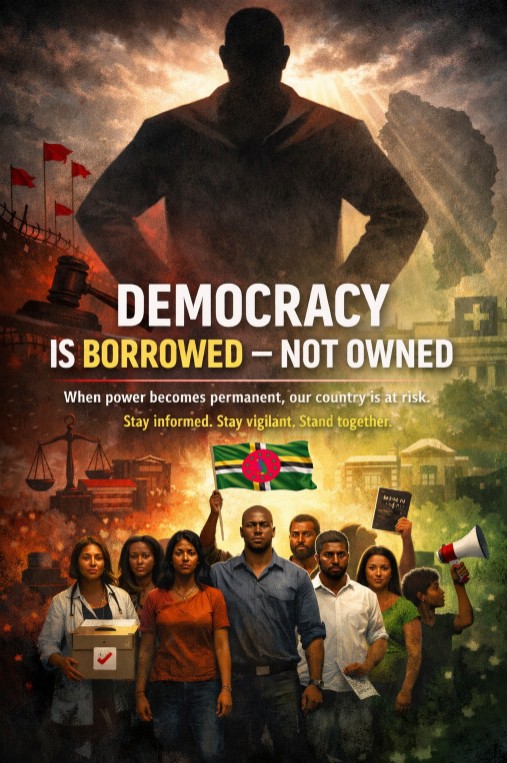
Dominica deserves leadership that understands the power it holds is borrowed from the people, not owned by one individual for life. If I do not call these concerns out now, if I do not insist on transparency, accountability, and the peaceful transfer of power through democratic processes. Then we risk further instability, further division, and a larger fracture in the very foundations of our society.
So, some might try to call this fear-mongering, but it is far from that. What I am pointing out is not an exaggeration or a tactic to provoke panic, it is a clear and present reality that cannot be ignored, Dismissing it as mere alarmism only serves to protect those who benefit from silence, those whose actions or inactions allow serious threats to grow unchecked. This is about the safety, the rights, and the future of our people.
It is about calling out risks that, if left unaddressed, could have real and lasting consequences. And anyone who refuses to see this for what it is does so at their own peril.
This is not an accusation. It is a warning!
What makes this even more concerning is that no other party leaders are willing to address it. Some are afraid, some are indifferent, and some simply don’t believe such a scenario could ever happen in Dominica. They remain silent, tethered to convenience, loyalty, or disbelief, unwilling to confront the reality that our democracy could be at risk.
They talk about elections, programs, and promises, but when it comes to the fundamental question of leadership accountability, they look away. Not the Dominica Reform Party. We will speak the truth, point out the risks, and hold all leaders – regardless of party – to the standards that democracy demands.