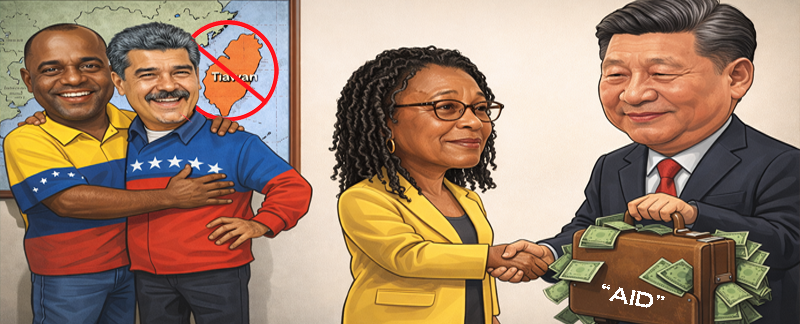
Once again, the Dominica Reform Party is the only party willing to speak openly about this issue. Where are the other party leaders? Silent. Hiding. Avoiding the conversation altogether.
Why? Because speaking out has consequences. It means challenging a system that benefits a small, powerful top one percent. It means risking comfort, access, and political safety. We are talking about it because we are not afraid to do so, and because our people deserve honesty, not silence.
This is exactly why Dominicans need to vote for the Dominica Reform Party. While others stay silent to protect their comfort and their connections to the top one percent, we speak up—even when it is uncomfortable.
We are not afraid of the consequences of telling the truth. We are not controlled by the same system that has kept our people divided, dependent, and struggling. If you want leaders who will challenge injustice instead of benefiting from it, then you already know who to vote for.
Real change does not come from silence. It comes from courage.
In June of 2025, the Dominica Reform Party published a post titled “Loyalty Over Logic: How Misinformation Is Failing Dominica.” At the time, many dismissed it as political exaggeration. Yet months later, the pattern highlighted in that post has become increasingly evident, crystallizing into a diplomatic strategy with real implications for Dominica’s security, sovereignty and future.
Dominica’s President, Sylvanie Burton, has made two defining foreign policy choices in the last week, a continued swift embrace of China’s “One China“ policy and a vocal call for the international community to respect Venezuela’s sovereignty and avoid external interference.
At first glance, these decisions may appear unrelated, one concerns East Asian geopolitics, the other regional diplomacy in South America. But when viewed together, a disturbing coherence emerges, a consistent prioritization of loyalty to corrupt distant power brokers over logic grounded in the government’s responsibility to the national interest.
China: Diplomatic Language as Currency.
When a small nation like Dominica publicly affirms China’s “One China” policy, recognizing the People’s Republic of China (PRC) as the sole legal government of Taiwan, while deliberately ignoring the fact that Taiwan has been self-governing for decades, it is not engaging in abstract rhetoric.
On March 23, 2004, Skerrit signed a joint communique with China recognizing the PRC as the sole legal government of China, stating Taiwan is an inseparable part of China, a cornerstone of the “One China” policy. This was Skerrit’s first official endorsement of the position as Prime Minister. Sylvanie Burton’s endorsement of this “One China” policy is not merely a symbolic statement, she is spreading Skerrit’s political views and personal admiration for China.
Immediately following Skerrit’s public agreement against the people of Taiwan, China quickly pledged financial aid as part of the new relationship, reportedly offering a package worth around US $12 million, including $6 million in budget support in 2004 and annual support for several years afterward. Another specific $8.2 million grant from China was signed not long after, with agreements formalized in the mid‑2000s.
This is not unusual in international relations, but it is not accidental either. Governments understand that certain words unlock certain doors. Supporting “One China” carries an implied acceptance that Taiwan’s self-determination and independence will become subordinated to China’s control, even if the Dominica government never openly endorses coercion or force. Silence on those deeper implications is itself a position.
The comparison with Dominica’s history is striking. Taiwan, like Dominica once did, and now does govern itself. Taiwan today operates as a self-governing entity, with its own government, military, elections and economy. Its people largely seek to remain autonomous, with some factions advocating formal independence. Yet China insists that Taiwan cannot be independent and must fall under their rule and control.
Sylvanie Burton’s Hypocrisy.
Sylvanie Burton’s public endorsement of the “One China” policy reveals a striking inconsistency when measured against the principles that once guided Dominica itself. By supporting a policy that denies Taiwan the right to self-governance, Sylvanie Burton is aligning with China against the autonomy of a self-governing people, even as Taiwan has operated independently for decades.
Remember back in 1978, here in Dominica, after political negotiation, local activism and self-determination movements, we finally achieved independence from Britain. When the British pulled out, the goal was full sovereignty, we wanted an island where we govern ourselves and manage our own affairs. Our leaders demanded sovereignty, self-determination and international recognition. This is exactly what Taiwan seeks right now, except China refuses to allow them to be that sovereign nation.
What was Sylvanie Burton’s position when Dominica was asserting its right to independence and freedom for our people in 1978 and the years leading up to it? Was she supporting the idea of us staying under British control? Likely not.
Yet Sylvanie Burton, by endorsing China’s claim over Taiwan, effectively supports the denial of the very principles Dominica once fought for. And yet today, she publicly advocates a position that subordinates Taiwan’s right to self-rule to a distant government, prioritizing political alignment and convenience over consistent principles.
This is not just a diplomatic stance, it is hypocrisy in action. Sylvanie Burton chooses political expediency and alignment with a powerful foreign nation over defending the universal right of a people to self-governance, showing a double standard that undermines her credibility on issues of independence and sovereignty.
Venezuela: Non‑Intervention and Regional Security.
Now, Sylvanie Burton has called for the international community to respect Venezuela’s sovereignty and avoid external interference. On its face, this sounds principled, who could argue with peace?
Glaring Hypocrisy: Taiwan vs. Venezuela.
Sylvanie Burton’s stance exposes a glaring double standard in her foreign policy positions. On one hand, she insists that the world must recognize China’s claim over Taiwan, effectively denying the small island’s decades-long self-governance. While on the other hand, she calls for the international community to respect Venezuela’s sovereignty, a nation plagued by corruption, political oppression and drug trafficking networks that destabilize the Caribbean. She asks the world to leave Venezuela “alone,” despite the clear spillover of drug cartels and their effects of crime, violence and drugs into neighboring countries, including Dominica.
The hypocrisy is stark, Sylvanie Burton dismisses the self-determination of a democratic, self-governing nation like Taiwan, while urging tolerance and respect for a government regime that actively undermines the safety, well-being and security of the Caribbean region. She prioritizes political alignment and appearances over consistent principles of sovereignty, self-rule and accountability.
This is not diplomacy; it is selective advocacy, where convenience and political favors take precedence over logic, justice and the very values Dominica itself once fought to uphold.
Comparison: China and Venezuela.
China and Venezuela are united by a common approach to power, tight control and self-preservation at the expense of their people. In China, the government suppresses dissent, censors information and enforces the “One China” policy, denying Taiwan’s self-governance. Decisions are centralized and loyalty to the ruling party outweighs the freedoms or aspirations of ordinary citizens.
Venezuela mirrors this pattern. Under Maduro, political power is concentrated, opposition is silenced and corruption runs rampant, with drug trafficking and state mismanagement fueling instability. Both governments prioritize control over accountability and both use their power to influence and intimidate others, whether it is smaller nations like Dominica or populations within their own borders.
Authoritarian Characteristics.
Does this sound familiar? Skerrit and his government mirror many of the same patterns seen in China and Venezuela, but on a smaller scale. By fully aligning Dominica with China and publicly supporting the “One China” policy, Skerrit has sacrificed the principle of supporting self-governance, just as China does with Taiwan.
Words of allegiance were quickly followed by Chinese financial aid and development projects, showing how diplomatic compliance can unlock benefits, a clear incentive structure similar to the way authoritarian leaders operate.
Meanwhile, the government’s support for Venezuela, despite the clear impact of its corruption and drug cartel networks on the Caribbean, demonstrates a willingness to prioritize political alliances over the safety and well-being our Dominician citizens.
By Sylvanie Burton’s public endorsement of both China and Venezuela, the Skerrit administration reveals a clear pattern of centralized decision-making, selective advocacy and a willingness to prioritize relationships with powerful authoritarian leaders over local accountability. This approach mirrors the very systems of control, corruption, and political dominance that define those regimes, raising serious questions about whose interests are truly being served.
We also have to wonder what is happening behind these closed-door deals that we do not see, deals that make Skerrit and his government so willing to align with and support dictatorships. Whatever is motivating these choices, the result is clear: Dominica’s leaders appear to prioritize foreign loyalty and hidden agendas over transparency, principle and the sovereignty of its own people.
Drug Trafficking and Regional Implications.
But there is also a glaring omission in Sylvanie Burton’s logic, which is the lived reality in the Caribbean. Our islands are not abstractions; they are destinations for drug routes originating largely in Colombia and Venezuela. These routes bring violence, murder, addiction and instability to communities already struggling with limited resources, such as those in Dominica.
To call for non‑intervention in Venezuela without simultaneously addressing the consequences of Venezuelan lawlessness, especially on our own shores, is not balanced diplomacy. It is willful blindness. It says, in effect – We accept the status quo in Venezuela, even though its spillover harms and kills our people.
Domestic Vulnerability.
One has to wonder whether Skerrit and his government are intentionally maintaining conditions that keep Dominica vulnerable. Persistent poverty, inadequate healthcare, an underperforming education system, high taxes and low wages do more than harm ordinary people, they create the exact environment in which drug trafficking networks thrive. When citizens are struggling to survive, criminal organizations find easier recruitment, weaker resistance and less community capacity to push back.
This is not speculation, it is a well-documented reality across the Caribbean and Latin America. Drug cartels do not choose stable, prosperous societies with strong institutions. They exploit weak governments and systems, economic desperation and poor governance, using small islands as stopovers and transit points precisely because oversight is limited and communities are stretched thin.
The uncomfortable question, then, must be asked. Who benefits from this dysfunction? Is it mere incompetence and mismanagement, or is there a tolerance, even an acceptance of conditions that allow these activities to continue? Are there people in positions of power who are indifferent to the suffering of the population because that suffering makes the country easier to exploit, control and quietly use for illicit purposes?
A government that truly prioritizes its people would invest aggressively in education, healthcare, fair wages and economic opportunity, not just as social goods, but as national security measures. Until that happens, Dominicans are left to question whether prolonged hardship is an accident… or a feature of the system itself.
Patterns, Not Coincidence.
Taken together, Sylvanie Burton’s stance toward China and Venezuela reveals a pattern of strategic alignment with powerful distant actors, even when the implications contradict our own security interests.
In June, we warned that misinformation and unexamined loyalty would fail Dominica. We argued that we must not accept political narratives that prioritize appearance over substance. Today, that warning feels prophetic..